


Creating healthy boundaries in personal and professional relationships is essential for maintaining emotional well-being. However, the challenge often lies in setting these boundaries without feeling guilty or selfish. Many people struggle with the idea of saying no or standing up for themselves due to fear of conflict, rejection, or the belief that they must always accommodate others.
This comprehensive guide will provide practical strategies, insights, and expert advice on how to set boundaries without feeling guilty.
Understanding Boundaries

At its core, a boundary is a limit we set to protect our well-being. This could be in terms of time, energy, emotions, or personal space. Boundaries are essential in every relationship whether with family, friends, colleagues, or romantic partners—as they help ensure that our needs are respected while also respecting others.
Why Do We Struggle with Boundaries?
Many people find it hard to set boundaries because they fear the repercussions. There is often a fear of disappointing others, being seen as rude, or potentially damaging the relationship. Social conditioning also plays a role, as people are often taught to prioritize others’ needs over their own.
Some common reasons people have difficulty setting boundaries include:
- Fear of Rejection: We worry that by setting a boundary, we will push others away.
- Guilt: We feel bad for saying no or asserting our needs.
- People-Pleasing Tendencies: A deep-rooted desire to make others happy can prevent us from standing up for ourselves.
- Lack of Confidence: We might not feel entitled to set boundaries, thinking we must always accommodate others.
- Cultural Norms: In some cultures, saying no is seen as disrespectful or inconsiderate, making it harder to assert boundaries.
Types of Boundaries
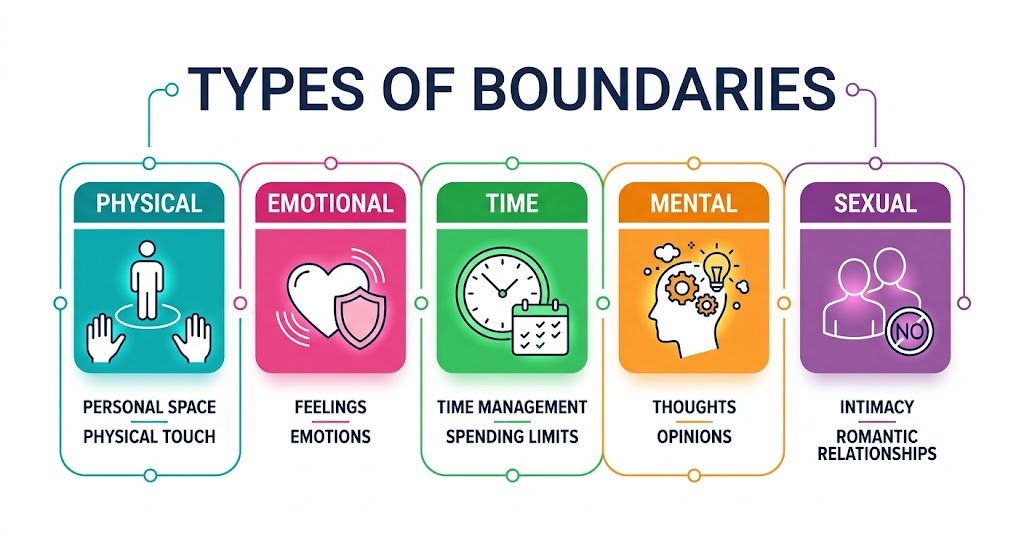
Before we can set boundaries effectively, it’s important to understand the different types that exist:
- Physical Boundaries: These involve your personal space, privacy, and physical touch. For example, deciding who can hug you or entering your room without knocking.
- Emotional Boundaries: These relate to your feelings and emotions. For instance, it’s essential to decide when you are too drained to listen to someone’s problems.
- Time Boundaries: These focus on how you manage your time, such as limiting how much time you spend with people who drain you.
- Mental Boundaries: These involve your thoughts, beliefs, and opinions. You have the right to protect your mental health by not tolerating manipulative behavior or unnecessary criticism.
- Sexual Boundaries: These pertain to your comfort level with intimacy, sexual activities, and personal space in romantic relationships.
Understanding these categories helps you identify which areas of your life need better boundaries.
The Psychological Impact of Guilt

Guilt is one of the most common emotions people experience when they attempt to set boundaries. However, guilt can be an unhealthy response. It often arises from the belief that by setting a boundary, you are being selfish or inconsiderate. This is especially true in situations where you feel responsible for others’ feelings.
The issue with guilt in this context is that it can lead to boundary violations. When we feel guilty about saying no, we tend to ignore our needs and continue to overextend ourselves, leading to stress, burnout, and resentment. Therefore, it is crucial to address the psychological impact of guilt in order to break this cycle.
Steps to Set Boundaries Without Guilt
Setting boundaries without feeling guilty is a process that requires self-awareness, self-compassion, and practice. Below are several actionable steps you can follow:
1. Know Your Limits
It’s important to understand your own needs, feelings, and limits before setting boundaries. This requires introspection. Ask yourself the following questions:
- What situations make me feel overwhelmed or resentful?
- Where do I feel drained or disrespected?
- What are my emotional, physical, or time-related limits?
Being clear on your limits will make it easier to identify when they have been crossed and allow you to assert your boundaries confidently.
2. Recognize the Role of Guilt
As discussed earlier, guilt is often the major obstacle in setting boundaries. It’s crucial to recognize that guilt is a learned emotional response, and it’s okay to feel it. However, feeling guilty doesn’t mean you are doing something wrong. Understand that setting boundaries is an act of self-care and not an act of selfishness.
If guilt arises, challenge it by reminding yourself that:
- You are entitled to take care of yourself.
- Setting a boundary is necessary for your mental and emotional health.
- The other person’s feelings are not your responsibility unless it’s done in a harmful or disrespectful way.
3. Practice Assertive Communication
Assertiveness is key to setting boundaries. Assertive communication involves expressing your thoughts, feelings, and needs directly and respectfully, without aggression or passivity. You don’t need to apologize for your needs.
Some examples of assertive phrases include:
- “I am not able to take on that task right now, as I have other commitments.”
- “I need some time to myself this weekend to recharge.”
- “I am uncomfortable with that topic, and I’d prefer we not discuss it.”
Learning to communicate assertively helps you set boundaries while maintaining healthy relationships.
4. Start Small
If setting boundaries feels overwhelming, start with small steps. Begin by asserting yourself in less intimidating situations before tackling more significant challenges. For example, start by saying no to a minor request at work or politely telling a friend you need some alone time. As you build confidence, you can move to more complex situations.
5. Prepare for Pushback
It’s possible that people may not respect your boundaries immediately. They might push back, feel hurt, or try to guilt-trip you into giving in. It’s important to be prepared for this and to remain firm in your decision. Stick to your boundary and don’t feel obligated to explain yourself repeatedly. Remember, your boundaries are about your well-being, and you are entitled to uphold them.
6. Be Consistent
Setting a boundary once is not enough. You must be consistent in enforcing it. If you allow people to cross your boundaries occasionally, they will learn that you don’t take your own limits seriously. Consistency is key to establishing long-term boundaries.
7. Practice Self-Compassion
Finally, practice being kind to yourself. It’s normal to feel guilty or conflicted at first, but don’t beat yourself up for having those emotions. Treat yourself with the same understanding and compassion that you would offer to a close friend. Self-compassion will help you stick to your boundaries without feeling guilty.
Examples of Healthy Boundaries in Different Areas
Below are examples of setting boundaries in various areas of life:
In the Workplace
- Time Boundaries: “I can’t stay late tonight because I have personal plans.”
- Emotional Boundaries: “I prefer not to get involved in office gossip.”
- Mental Boundaries: “I disagree with that approach, and I would like to present an alternative idea.”
In Friendships
- Time Boundaries: “I love hanging out, but I need some alone time this weekend.”
- Emotional Boundaries: “I’m feeling overwhelmed right now, so I’m not able to listen to your problems today.”
- Physical Boundaries: “Please don’t touch my belongings without asking.”
In Romantic Relationships
- Sexual Boundaries: “I’m not ready for that level of intimacy yet.”
- Time Boundaries: “I need time for my own hobbies and interests.”
- Emotional Boundaries: “I can’t handle conversations about this right now; can we talk about it later?”
Tools to Help Reinforce Boundaries
Several tools and techniques can help reinforce boundaries:
- Journaling: Writing down your thoughts and feelings can help clarify your boundaries and understand where you need to assert them.
- Meditation and Mindfulness: These practices can help you stay grounded and prevent guilt from taking over when asserting your needs.
- Support System: Talk to trusted friends or a therapist who can help you process your feelings and reinforce the importance of boundaries.
The Impact of Healthy Boundaries
Setting healthy boundaries without guilt leads to a more balanced and fulfilling life. It enhances self-esteem, reduces stress, and promotes better relationships. By practicing self-respect, you show others how to treat you with respect as well. Over time, your confidence in setting boundaries will grow, and you will no longer feel guilty about protecting your mental, emotional, and physical space.
Final Thoughts
Setting boundaries is not an easy task, but it is one of the most important skills for maintaining your well-being. By understanding your limits, recognizing guilt as a normal emotion, and practicing assertive communication, you can set boundaries without feeling bad about it. Remember that your needs are just as important as those of others, and by setting clear boundaries, you are ultimately fostering healthier, more respectful relationships.