


ADHD in school age children is often misunderstood. Many people still think it only means a child is loud, wild, or unable to sit still. That is not enough. ADHD can look loud, quiet, messy, emotional, forgetful, restless, careless, sensitive, funny, stubborn, or even “lazy” from the outside.
The blunt truth is this: many adults judge ADHD by the behavior they can see, but the real problem is usually happening underneath. A child may know the rule and still break it. A child may understand the lesson and still fail to finish the worksheet. A child may care about school and still forget the homework. That gap between knowing and doing is one of the clearest signs adults need to understand.
School makes ADHD easier to notice because school demands many skills at once. A child has to sit, listen, remember, write, wait, organize, control emotions, follow directions, shift between tasks, and work even when bored. For a child with ADHD, that can feel like being asked to carry ten bags while everyone else carries three.
ADHD is not just “not paying attention”
The name ADHD can be misleading. Many children with ADHD can pay attention very well when something is exciting, funny, new, fast, or personally interesting. The real issue is not always a lack of attention. It is poor control over attention.
A child with ADHD may focus deeply on a game, a favorite book, drawing, sports, animals, or building something. Then the same child may seem unable to finish ten math questions or copy three sentences from the board. Adults may say, “You focused on your tablet for an hour, so I know you can focus.” That sounds logical, but it misses the point.
Interest can switch attention on. Boring, slow, repeated, or hard tasks often do not. That is why ADHD can look inconsistent. The child may perform well one day and badly the next. They may do well in science but fail to finish writing. They may remember every fact about dinosaurs but forget their lunchbox every week.
| What adults see | What may really be happening |
|---|---|
| The child does not listen | They heard the first part but lost the rest |
| The child is careless | They rushed, missed details, or forgot a step |
| The child is lazy | They may not know how to start |
| The child is rude | They may speak before their brain slows down |
| The child is messy | They may struggle to sort, plan, and remember |
| The child only works when watched | Adult presence may be helping them stay on task |
| The child argues | They may be trying to avoid shame, failure, or overload |
| The child keeps losing things | They may not have a reliable system for belongings |
The mistake is assuming the child is choosing every problem on purpose. Sometimes they are making poor choices. But often, the same weak skills keep breaking down again and again.
What ADHD can look like in the classroom

In school, ADHD can show up during lessons, group work, tests, reading, writing, lunch, recess, and pack-up time. It rarely affects only one part of the day. The signs may change depending on the task.
A child may sit well during story time because they like stories, then fall apart during writing because writing requires planning, spelling, memory, hand control, and patience all at once. Another child may behave during math because the work feels clear, but struggle during open-ended projects because there are too many choices.
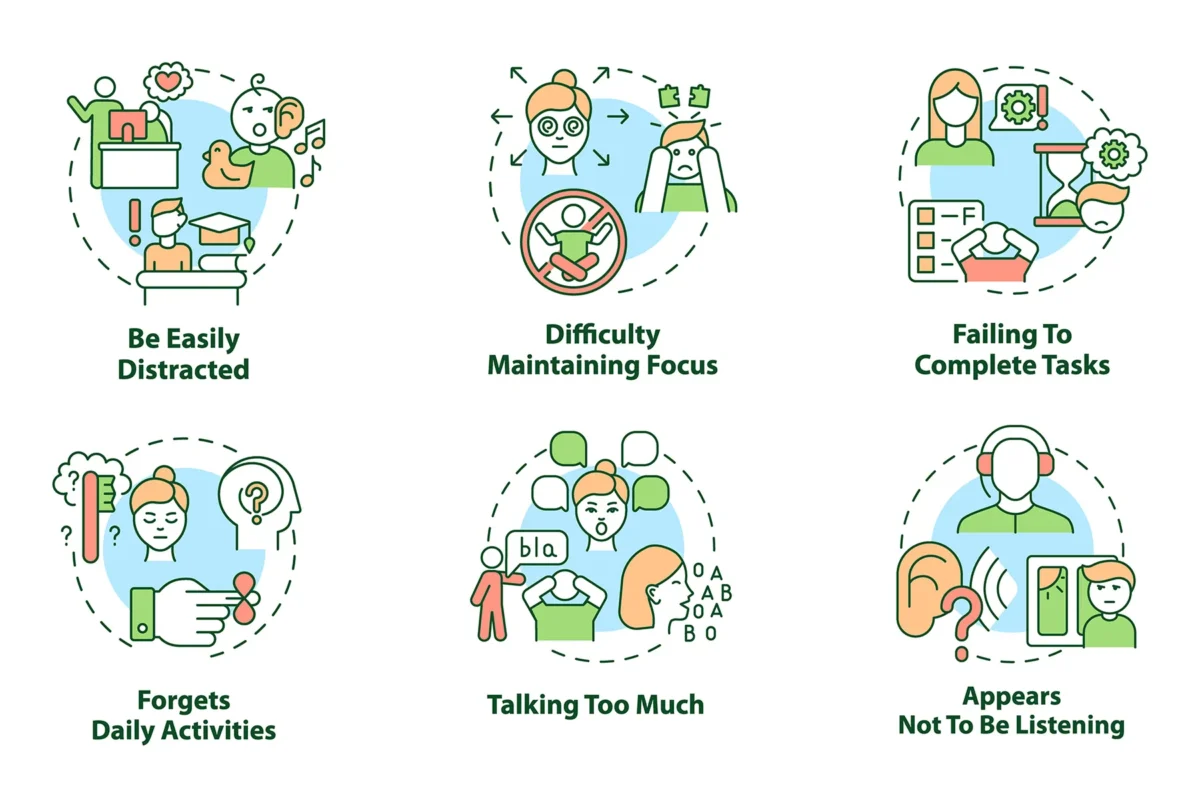
Common classroom signs include forgetting instructions, asking what to do after the teacher just explained it, leaving work unfinished, rushing through easy tasks, making small mistakes, talking at the wrong time, interrupting, losing materials, reacting strongly to correction, and struggling to shift from one activity to another.
Some children are easy to notice because they move around, talk loudly, touch things, or disturb others. Others are harder to notice because they sit quietly and disappear into their own thoughts. The quiet child may be just as stuck as the loud one.
A useful way to understand ADHD in school is to look at pressure points. These are the moments where the child’s weak skills show up most often. For one child, the pressure point may be independent writing. For another, it may be lining up after recess. For another, it may be remembering homework. When adults find the pressure point, they can build better support.
Inattention: the quiet ADHD many adults miss
Inattention does not always mean the child is staring out the window. It can mean the child starts but does not finish, reads without understanding, misses details, forgets materials, loses track of time, or seems confused even after directions were given.
This type of ADHD can be missed because it does not always disturb the class. A quiet child may look polite and calm, but inside they may be lost, overwhelmed, or mentally drifting. Teachers may say the child is sweet but slow. Parents may say the child takes forever to do homework. The child may say, “I don’t know,” because they missed the instruction and feel embarrassed.
A child with inattentive ADHD might open a workbook, sharpen a pencil, look around, erase something, write one word, then forget what they were doing. Adults may think the child is wasting time. The child may actually be stuck between steps.
Inattention often affects multi-step directions. A teacher may say, “Take out your notebook, write the date, copy the question, and answer in three sentences.” A child with ADHD may take out the notebook and then forget the rest. If the teacher gets annoyed, the child may feel stupid, even though the issue was memory and attention control.
Practical support for inattention should be simple. Written directions help. Short checklists help. One instruction at a time helps. Asking the child to repeat the direction back can help. So can reducing clutter on the desk, using a clear turn-in folder, and checking progress early instead of waiting until the end.
The worst response is repeating “pay attention” all day. That tells the child what they are failing to do, but it does not teach them how to do it.
Hyperactivity: when the body keeps asking to move
Hyperactivity is the ADHD sign most people recognize. It may look like running, climbing, tapping, squirming, rocking, humming, chewing, touching, or constantly changing position. In younger school children, it may be obvious. In older children, it may become less visible but still present.
A six-year-old may leave the carpet during story time. A nine-year-old may stay seated but tap the pencil, swing the legs, and talk to nearby classmates. A twelve-year-old may not run around, but they may feel restless inside and struggle badly during long lessons.
Movement is not always bad. Some children with ADHD move because movement helps them stay alert. The goal is not to force every child to sit like a statue. The goal is to make movement safe, quiet, and respectful of others.
A child who rocks in a chair may need a safer seat option. A child who keeps standing may need a standing spot for part of the lesson. A child who talks during quiet work may need a short movement job before starting. A child who touches everything may need something appropriate to hold.
Adults often make the mistake of removing movement as punishment. Taking away recess from a restless child can backfire. Recess may be the very thing helping the child regulate their body. That does not mean behavior should be ignored. It means the solution should match the problem.
Better supports include short movement breaks, classroom jobs, standing workspaces, quiet fidget tools with clear rules, seating near the teacher, and tasks broken into shorter work periods.
Impulsivity: the action happens before the thinking
Impulsivity means the child acts too fast. They may blurt out answers, interrupt stories, grab materials, push ahead in line, rush through work, click the wrong thing, say hurtful words, or run without checking safety.
Impulsivity can look rude. Sometimes it causes real harm. A child may knock over another child’s project, spoil a game, interrupt a teacher, or shout out something embarrassing. The impact matters, and the child should still learn to repair the damage.
But adults also need to understand that impulsivity is not always planned misbehavior. The child may act before the “pause button” works. They may regret the behavior afterward. They may even say, “I don’t know why I did that.” That answer sounds fake to adults, but it can be true.
The child may need direct teaching in waiting, asking, stopping, and repairing. For example, instead of only saying, “Stop grabbing,” teach the exact replacement: “Can I use that after you?” Instead of only saying, “Don’t interrupt,” teach: “Put one finger on the desk and wait until the speaker stops.” Instead of only saying, “Don’t rush,” teach a check routine before turning in work.
Impulsive children need practice before the problem moment. Teaching calm behavior during a meltdown is usually too late. The child needs scripts, routines, and repeated practice when their brain is calm enough to learn.
Emotional signs: the part adults often call attitude
Many children with ADHD have strong emotions. They may cry quickly, anger quickly, quit quickly, panic quickly, or feel embarrassed quickly. A small correction can feel huge. A lost game can feel like a disaster. A hard worksheet can lead to tears or refusal.
This is one of the most misunderstood parts of ADHD. Adults may call the child dramatic, spoiled, rude, or too sensitive. Sometimes the child is behaving badly. But often the emotional reaction is tied to weak self-control, low frustration tolerance, repeated failure, or shame.
Children with ADHD hear more correction than other children. “Sit down.” “Stop talking.” “Where is your homework?” “Why didn’t you finish?” “Listen.” “Hurry up.” “Be careful.” After years of this, many children start to believe they are the problem.
That belief can be damaging. A child who thinks “I am always bad” may stop trying to be good. A child who thinks “I am stupid” may avoid schoolwork. A child who thinks “Adults only notice my mistakes” may become defensive before anyone even corrects them.
Adults should still hold boundaries, but the language matters. “You are being bad” is weaker than “That choice was not okay. Here is what you need to do now.” “Stop overreacting” is weaker than “This feels big. First we calm your body, then we fix the problem.”
The order matters: calm first, teach second. A child in a full emotional storm is not ready for a long lecture.
ADHD during homework
Homework often shows ADHD clearly because the child is tired after school. They may have used all their self-control during the day. By the time they get home, they may avoid work, argue, cry, lie about assignments, or sit for an hour with almost nothing finished.
Parents may think the child is being lazy. Sometimes avoidance becomes a habit, but the original problem is often deeper. Homework requires memory, planning, starting, focus, handwriting, reading, patience, and finishing. For a child with ADHD, that can be too much without structure.
A common homework pattern looks like this: the child says they have no homework, then the parent finds out later they did. The child may not be lying in a calculated way. They may have forgotten, avoided checking, or felt so overwhelmed that saying “no homework” became an escape.
Another pattern is the child completing the homework but forgetting to turn it in. This is classic ADHD-style breakdown. The learning happened. The work was done. The grade still drops because the final step failed.
| ADHD problem during homework | What it can look like | Better support |
|---|---|---|
| Trouble starting | Child stares, complains, delays | Begin with the easiest task and a short timer |
| Forgetting assignments | Child says there is no work | Use a planner, teacher note, or online check |
| Losing papers | Work disappears in bag | Use one homework folder only |
| Slow work | Twenty minutes of work takes two hours | Use short work blocks with breaks |
| Rushing | Child finishes fast with many errors | Add a check routine before finishing |
| Emotional shutdown | Child cries or refuses | Pause, calm down, restart with a smaller piece |
| Not turning work in | Completed work stays in bag | Put finished work in a fixed pocket or folder |
The best homework setup is predictable. Same place. Same start routine. Same folder. Same order. Same pack-up step. ADHD does not improve when every afternoon becomes a fresh negotiation.
ADHD and grades
A child with ADHD can be smart and still get poor grades. This confuses adults, but it should not. School grades measure more than intelligence. They also measure attention, planning, memory, organization, time use, writing output, emotional control, and follow-through.
A child may understand the lesson but fail the worksheet. They may answer questions well out loud but write almost nothing on paper. They may know the math process but skip signs, lose place, or forget to check their answer. They may study but forget the test date. They may finish the project but leave it at home.
This is why adults should not say, “You are too smart for this.” That sentence is usually meant to motivate, but it often creates shame. The child already knows they are underperforming. They may not know how to fix it.
A better message is: “Your understanding is stronger than your system. We need to fix the system.”
That means looking at where the breakdown happens. Is the child failing to start? Losing materials? Forgetting due dates? Rushing? Avoiding writing? Missing directions? Turning work in late? Each problem needs a different support.
Punishing a child for a missing system does not create a system. Adults need to teach the steps clearly and repeat them until they become routine.
ADHD in girls
Girls with ADHD are often missed, especially when they are not hyperactive in obvious ways. A girl with ADHD may be quiet, dreamy, talkative, anxious, messy, emotional, perfectionistic, or slow to finish work. She may try hard to hide her problems because she wants to please adults.
Teachers may describe her as bright but scattered. Parents may say she cries over homework. She may spend far longer than other children on assignments because she is trying to compensate. Her grades may look fine for a while, but the cost may be stress, exhaustion, and low self-esteem.
Girls may also be more likely to mask their symptoms in school and then fall apart at home. A parent may see tears, anger, or shutdown after school, while the teacher says, “She seems fine here.” Both can be true. The child may be using all her energy to hold herself together in public.
Signs that should not be ignored include chronic disorganization, extreme homework time, frequent daydreaming, forgotten items, emotional reactions to mistakes, slow written output, and anxiety about school tasks.
The blunt truth: being quiet does not rule out ADHD. Being polite does not rule out ADHD. Getting decent grades does not rule out ADHD if the child is paying for those grades with constant stress and parent support.
ADHD in boys
Boys with ADHD are often noticed sooner because their symptoms may be more visible. They may move more, interrupt more, act rougher at recess, talk loudly, joke during lessons, or get into trouble for impulsive behavior.
That visibility can lead to earlier help, but it can also lead to harsh labels. A boy may be called the bad kid, class clown, troublemaker, or attention seeker. Those labels can become part of his identity if adults are not careful.
Boys still need accountability. If a child pushes, grabs, insults, or disrupts, the behavior must be addressed. But the adult should also ask what skill is missing. Does the child know how to wait? Ask? Lose a game? Join a group? Stop when excited? Use a calm voice? Handle correction?
Many boys with ADHD need direct teaching in body control, personal space, safe play, turn-taking, and repair after mistakes. They also need chances to succeed in ways that use their energy well: helping with classroom jobs, sports, building tasks, hands-on learning, and leadership roles with clear boundaries.
The mistake is trying to crush the energy out of the child. The smarter move is to shape the energy into something useful and safe.
ADHD and friendships
ADHD can damage friendships. This is one of the hardest parts for children because they may want friends badly but keep doing things that annoy or upset other children.
They may interrupt, talk too much, grab toys, change rules, get angry when losing, act silly at the wrong time, miss facial expressions, or fail to notice when others are getting irritated. Other children may start avoiding them.
Friendship problems are not always about being mean. Often, the child with ADHD is socially fast but socially inaccurate. They jump in too quickly. They miss the pause. They do not read the room. They react before thinking.
Adults can help by teaching exact social scripts. General advice like “be nice” is too vague. Better scripts include “Can I play?” “Can I have a turn after you?” “Good game.” “I need a break.” “Sorry, I grabbed it. Here you go.” “What do you want to play?”
Small supervised groups can help more than large free-play settings. A child who struggles on the playground may do better in a structured game with clear rules and an adult nearby.
Friendship repair is also important. Children with ADHD need to learn that mistakes can be fixed. A real apology, returning an item, helping rebuild a project, or using better words next time teaches responsibility without crushing the child.
ADHD and lying, arguing, or avoiding work
Some children with ADHD lie, argue, or avoid tasks. Adults often see this as a character problem. Sometimes it is a behavior habit that needs firm correction. But often it starts as an escape from shame, confusion, or overload.
A child may say, “I already did it,” because starting feels impossible. They may say, “The teacher never told us,” because they forgot the instruction. They may argue for ten minutes because arguing delays the task. They may act silly because being the clown feels safer than looking stupid.
This does not mean adults should accept lying or arguing. It means adults should respond with less drama and more structure.
Instead of asking, “Why did you lie?” for twenty minutes, the adult can say, “The work is not done. We are fixing that now. Start with the first two questions.” Later, when the child is calm, the adult can talk about honesty and repair.
Long lectures usually fail with ADHD. The child may tune out, become defensive, or remember only the anger, not the lesson. Short, clear, firm responses work better.
A useful rule is this: do not turn every task into a courtroom trial. Find the fact, give the next step, follow through.
How ADHD is different from normal childhood behavior
Every child is distracted sometimes. Every child forgets things sometimes. Every child interrupts sometimes. Every child gets restless or emotional sometimes. That does not mean every child has ADHD.
ADHD is different because the pattern is stronger, more frequent, longer-lasting, and more harmful than expected for the child’s age. It affects school, home, friendships, or daily routines in a real way.
A child having a messy week is not the same as a child losing work all year. A child interrupting when excited is not the same as a child interrupting all day despite reminders. A child avoiding one boring assignment is not the same as a child melting down over homework most nights.
| Normal childhood behavior | ADHD concern |
|---|---|
| Gets distracted during a boring lesson | Gets distracted across many lessons and needs repeated support |
| Forgets homework once in a while | Forgets homework often, even with reminders |
| Gets restless after sitting too long | Struggles to sit through normal class routines |
| Interrupts when excited | Interrupts often and cannot stop easily |
| Has a messy desk sometimes | Loses papers, books, and supplies again and again |
| Gets upset after losing | Has intense reactions that disrupt games or class |
| Needs reminders sometimes | Needs reminders for the same basic routines daily |
The key question is not “Does this child ever do these things?” The better question is “Does this happen often enough to cause real problems?”
What teachers may notice first
Teachers often notice ADHD because they compare one child with many children of the same age. A parent may think, “This is just how my child is.” A teacher may see that the child needs far more reminders, movement, correction, or help than classmates.
Teachers may notice that the child cannot follow multi-step directions, finishes less work than peers, distracts nearby students, loses materials, has peer conflict, rushes through tests, or needs an adult nearby to complete tasks.
Parents should not ignore repeated teacher concerns. One teacher can be wrong. A pattern across teachers, years, and settings deserves attention.
At the same time, teachers should describe specific behaviors, not just labels. “He is lazy” is not useful. “He starts independent work late and finishes less than half unless an adult checks in” is useful. “She does not care” is not useful. “She forgets to turn in completed homework three times a week” is useful.
Specific behavior leads to specific support. Vague criticism leads to blame.
What parents may notice first

Parents often see ADHD during morning routines, homework, chores, bedtime, and emotional moments. These are times when the child has to manage themselves without the structure of school.
A parent may notice that the child takes forty minutes to get dressed, forgets shoes, leaves the lunchbox behind, loses school papers, melts down over homework, talks nonstop, or cannot clean a room without step-by-step help.
Parents may also notice that the child does better with one parent than another. This does not always mean one parent is “better.” It may mean one parent gives clearer routines, shorter directions, or more consistent follow-through.
Home structure matters. A child with ADHD usually does worse in vague systems. “Clean your room” may be too broad. “Put dirty clothes in the basket, books on the shelf, and toys in the bin” is better.
The child may need the task shown, started, and checked. That is not weakness. That is skill-building.
Diagnosis: what adults should understand
A proper ADHD diagnosis is not based on one bad day or one frustrated teacher. It requires a pattern of symptoms that affects daily life. Information is usually gathered from parents, teachers, and the child’s history.
The evaluation should also consider other issues that can look like ADHD. Poor sleep, anxiety, learning problems, vision or hearing trouble, stress, trauma, depression, and some medical conditions can cause attention or behavior problems.
That is why guessing is risky. A child who cannot focus because they are anxious needs a different plan from a child who cannot focus because of ADHD. A child who avoids reading because of dyslexia needs reading support, not only behavior correction. A child who is tired because they sleep badly may look inattentive for a different reason.
The practical point is simple: look at the whole child, not just the annoying behavior.
School supports that actually help
Children with ADHD need clear systems. They usually do not improve just because adults tell them to try harder. Trying harder is not a plan. A real plan changes the setup around the child so the weak skill has support.
Helpful supports are often simple: written directions, short work chunks, seating away from distractions, private signals, visual schedules, planner checks, movement breaks, turn-in routines, and calm reset plans.
| ADHD difficulty | Helpful school support |
|---|---|
| Misses directions | Give written steps and ask the child to repeat them |
| Starts work late | Give the first step directly and check early |
| Gets distracted | Seat near instruction and away from busy areas |
| Talks out of turn | Use a private signal and planned speaking chances |
| Loses papers | Use one clear folder for finished work |
| Rushes tests | Add a short check routine before turning in |
| Needs movement | Use short movement breaks or classroom jobs |
| Struggles with writing | Use sentence starters or a writing frame |
| Melts down | Use a calm space, then restart with a smaller task |
| Forgets homework | Use daily planner checks or digital reminders |
The best supports are not complicated. They are consistent. A simple plan used every day beats a fancy plan used for one week.
What parents can do at home
Parents should be firm, but they should stop acting shocked by repeated ADHD patterns. If the child forgets the same thing every morning, the answer is not more yelling. The answer is a better routine.
A good home system has fewer words and more visible structure. Use checklists. Put items in fixed places. Prepare school materials the night before. Use short work blocks for homework. Keep screens out of the homework area. Break chores into small steps. Praise the exact behavior you want repeated.
Instead of saying, “How many times do I have to tell you?” say, “Check the list.” Instead of saying, “You are so lazy,” say, “Start with the first problem.” Instead of saying, “Why can’t you remember?” say, “Put it in the homework folder now.”
This is not being soft. It is being effective.
Parents should also protect the relationship. If every evening becomes a fight about school, the child starts to feel like home is only another place to fail. That does not mean parents should ignore homework. It means the routine should reduce arguing, not create more of it.
Common adult mistakes
Adults often make ADHD worse without meaning to. They lecture too long, correct publicly, give vague directions, remove movement, argue with the child, change rules often, or only notice mistakes.
A child with ADHD may already feel behind. More shame does not build skill. It usually creates defensiveness, avoidance, or anger.
Bad adult habits include saying “be good” without explaining the behavior, saying “focus” without giving a focus tool, punishing lost homework without fixing the folder system, and expecting the child to remember routines that have failed all year.
A better adult habit is to ask, “What system would make this harder to mess up?”
If the child forgets homework, create a folder system. If the child rushes, create a checking step. If the child interrupts, create a signal. If the child gets overwhelmed by writing, create a sentence frame. If the child melts down after recess, create a reset routine.
The adult’s job is not only to demand better behavior. The adult’s job is to build the path to better behavior.
ADHD in bright children
Bright children with ADHD are often judged harshly because adults think intelligence should cancel out ADHD. It does not. A child can be smart and still disorganized. A child can explain ideas well and still fail to write them down. A child can understand math and still lose points from skipped steps.
These children often hear, “You are wasting your potential.” That may be true, but it is not useful unless it comes with a plan. The child may already know they are underperforming. Repeating that fact does not fix attention, planning, or follow-through.
Bright children with ADHD may also use intelligence to hide problems. They may guess well, talk well, or finish at the last minute. This can work for a while, but as school demands increase, the weak system shows.
The support should not be to lower expectations automatically. The support should help the child meet expectations with better structure. That may mean project checkpoints, written rubrics, planning sheets, reminders, and help breaking large work into smaller parts.
ADHD in quiet children
Quiet ADHD is easy to miss. These children may not cause trouble, so adults may not notice how much they are struggling. They may sit still but miss the lesson. They may seem calm but feel lost. They may be called slow, dreamy, forgetful, or unmotivated.
A quiet child with ADHD may take much longer than classmates to finish tasks. They may avoid raising their hand because they are unsure what is happening. They may bring home unfinished work but not know how to explain why.
These children need check-ins that do not embarrass them. A teacher can quietly ask, “Show me where you are starting.” A parent can ask, “What is the first step?” The goal is to catch the child early, before they sit lost for half an hour.
Quiet struggle is still struggle. A child should not have to disrupt the class to receive help.
ADHD and self-esteem
Self-esteem is a major issue for school age children with ADHD. Many of them hear correction all day. Even when adults are not being cruel, the child may feel constantly wrong.
Over time, the child may start saying things like “I’m stupid,” “I can’t do it,” “Nobody likes me,” or “I always mess up.” Some children hide shame with anger. Others hide it with jokes. Others stop trying.
Adults should separate the child from the behavior. “You are bad” is damaging. “That behavior was not okay” is clearer and safer. The child needs to know that mistakes can be repaired and skills can be built.
Specific praise helps more than general praise. “Good job” is fine, but “You started right after the direction” is better. “You checked your work before turning it in” is better. “You used words instead of grabbing” is better.
Children repeat what adults notice. If adults only notice failure, failure becomes the child’s identity.
When ADHD looks like defiance
ADHD can look like defiance, especially when a child refuses work, ignores directions, argues, or walks away. Sometimes the child is being defiant. But often, the behavior begins when the child feels overwhelmed, confused, embarrassed, or unable to start.
The difference matters because the response should be different. If the child does not understand the task, punishment will not teach it. If the child is avoiding shame, public scolding will make it worse. If the child is arguing to delay work, arguing back rewards the delay.
A better response is calm and direct: “You do not have to like it. You do have to start. First line now.” Then stay close enough to make the start happen.
Defiance should not be ignored, but adults should avoid turning every moment into a power struggle. Win the routine, not the argument.
What adults should track before seeking help
Before asking for school or medical help, adults should track patterns. Good information is more useful than emotional complaints.
Track when the problem happens, where it happens, what came before it, what the child did, how adults responded, and what helped. Look for repeated trouble spots.
| Pattern to track | Useful example |
|---|---|
| Time of day | Worse after lunch or near the end of school |
| Subject | Most trouble during writing or reading |
| Task type | Struggles with open-ended work |
| Direction type | Loses multi-step instructions |
| Social setting | Conflict happens mostly during recess |
| Emotional trigger | Correction leads to tears or anger |
| Organization issue | Homework completed but not turned in |
| Body needs | Restlessness increases after long sitting |
| Sleep connection | Symptoms worse after late nights |
| Helpful support | Short checklist improves work completion |
This kind of tracking helps adults stop guessing. It also makes meetings with teachers or clinicians more useful.
Final bottom line
ADHD in school age children is not one simple behavior. It is a repeated pattern of trouble with attention control, impulse control, movement, organization, emotional regulation, and follow-through.
It can look loud or quiet. It can look like careless mistakes, lost homework, messy desks, constant talking, emotional outbursts, unfinished classwork, friendship trouble, or homework battles. It can also hide behind good grades, politeness, intelligence, or strong effort.
The biggest mistake adults make is asking, “Why won’t this child just behave?” The better question is, “Which skill is breaking down, and what support makes that skill easier to use?”
A child with ADHD does not need pity. They need structure, direct teaching, fair limits, movement options, emotional support, and adults who stop confusing weak self-management with bad character.